Find my articles here:
Placeholder post title
Placeholder post title
Placeholder post title
Placeholder post title
August 19, 2026
Somewhere between one open browser tab and the next, my appetite for anything AI-shaped led me to empathy.ai. It is a platform built on an ethic I recognise straight away: privacy is respected, surveillance techniques are refused, and the electricity draw of data centres and its effect on the environment is treated as a real question rather than a footnote. Their hosting runs on a net-zero bioclimatic data centre — the first of its kind in Asturias.
While using their chat, something else caught my eye. They show you the footprint of the response you just received.
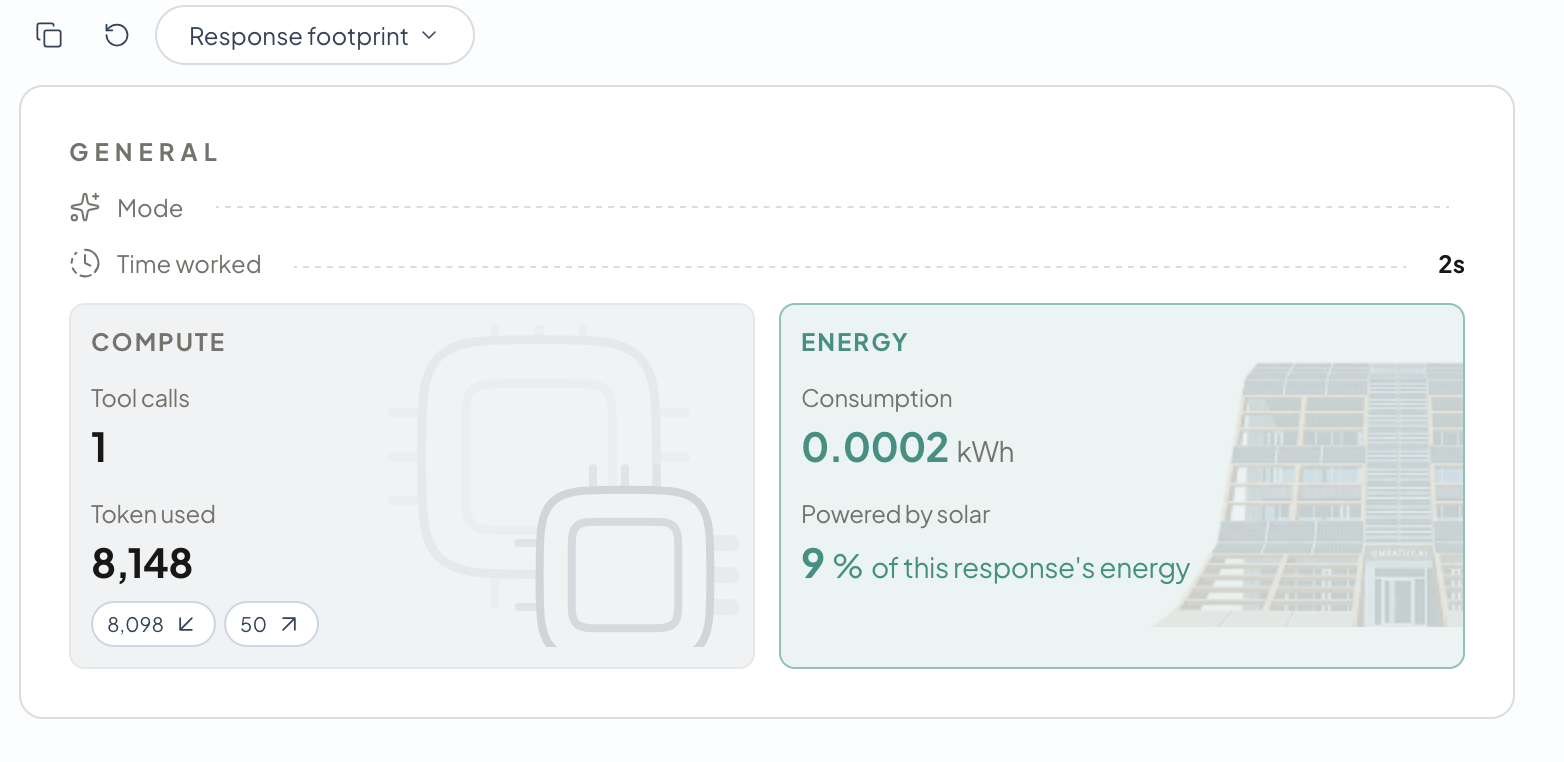
empathy.ai shows the footprint of every response. Recreated from their interface.
Good that they do this. Almost nobody does. And yet, sitting there as a user, I looked at 0.0002 kWh and felt nothing at all. Is that a lot? Is it nothing? Next to what?
The number was honest. It simply wasn't legible.
The penny dropped later, listening to Is AI een zeepbel, the NRC podcast by Stellinga and Schinkel. They quoted a scenario from MIT Technology Review's series Power Hungry: AI and our energy future:
15 questions to a chatbot, 10 attempts at an image for a flyer, and three attempts at a five-second video for Instagram.
2.9 kilowatt-hours. Enough to run your washing machine three times at 40 degrees.
Three washes. That one I can hold in my head. I know what a wash costs, roughly, since I pay for it every month and I know how long the machine hums.
What surprised me more was the shape of that evening. The 15 questions were a rounding error. The 10 image attempts, near enough nothing. Almost the entire 2.9 kWh sat in three short videos — the last thing you'd do, at the end of the evening, without a second thought. There was nowhere at all to find that out. Not while working, not afterwards, not in a monthly summary.
That is what turned a nice feature into an idea.
Take what empathy.ai already shows, and add the one thing that makes a number mean something: a comparison. Not a kilowatt-hour on its own, but a kilowatt-hour next to a washing machine, a car, a fridge. And a breakdown, so you can see which part of your evening was expensive.
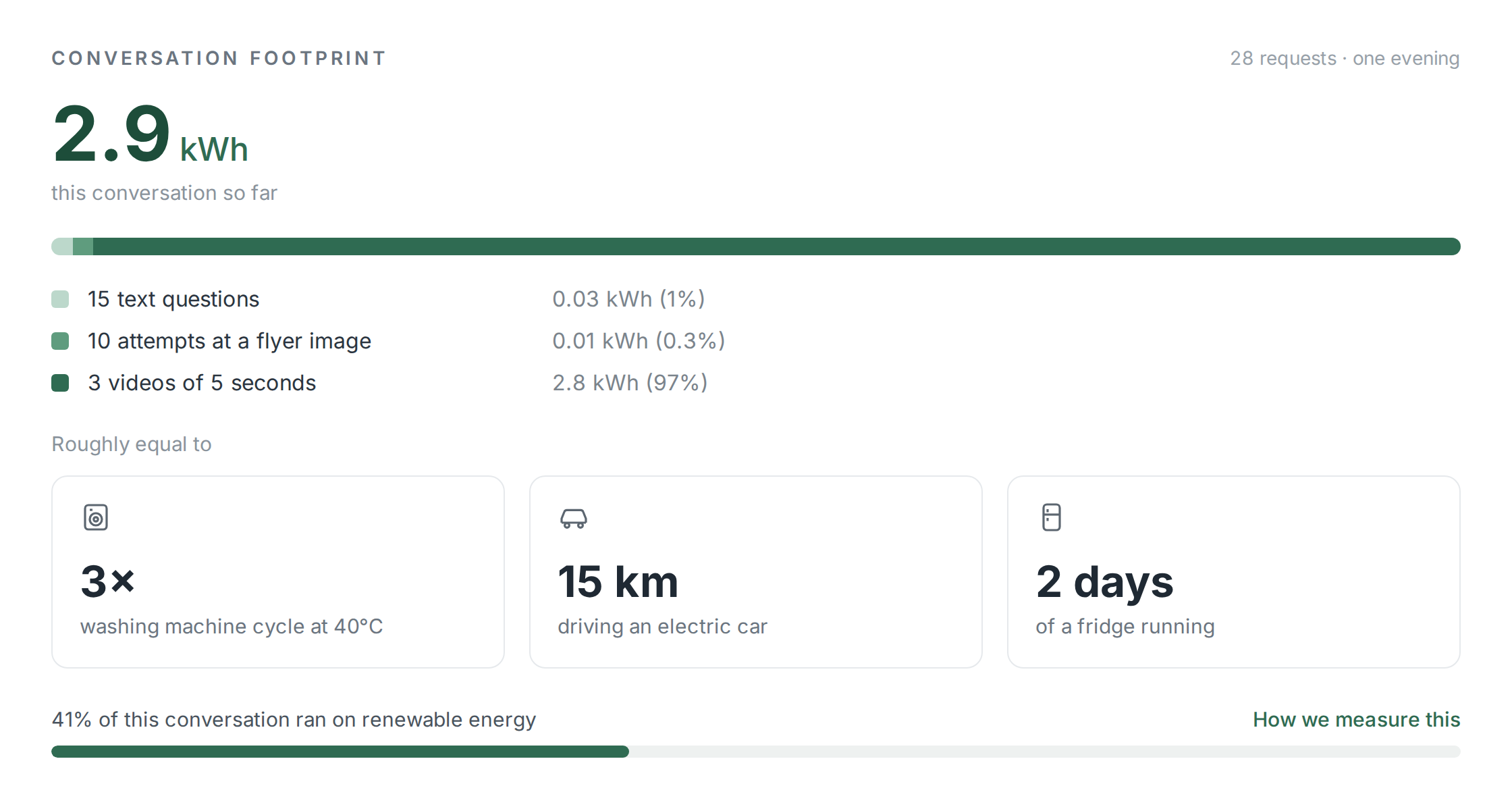
What that could look like. Figures from the MIT Technology Review scenario.
The point is not to make anyone feel guilty about asking a chatbot a question. Fifteen questions cost less than boiling a kettle. The point is that right now you cannot tell the cheap thing from the expensive thing, so you have no reason to think about either.
There is a reason the big chat providers don't show this. MIT Technology Review put the question directly to OpenAI, Google and Microsoft. All three declined to hand over figures. The measurements that exist come from open models researchers can download and meter themselves. ChatGPT, Claude, Gemini and Grok publish nothing — not to users, not to regulators, not to researchers.
This is not a technical problem. These companies measure their own consumption down to the kilowatt-hour, since they pay the bill. They just don't publish it. And the first company to open up would be the only one looking bad, which is precisely why three years of voluntary schemes have gone nowhere.
Europe has put a label on fridges for over thirty years. Then on washing machines, lamps, televisions, cars and houses. A plane ticket carries its CO₂ figure. A packet of biscuits lists what's inside it. Every time, the argument was the same: whoever uses something may know what it costs. Every time, it turned out to be possible.
Only for the fastest-growing electricity demand of the moment does nobody know a thing.
So I've started an online petition to put this to the EU as a proposal: oblige AI providers to show the electricity consumption of each response, in the app, at the moment it happens.
I'm under no illusion about the timescale. This is a long game, and part of what draws me to it is finding out how a thing like this actually moves. The first step is support from local and national parties with an outspoken environmental position — Volt, D66 and Pro come to mind.
Sign it, and you'll hear how it goes.
Sources